
By Ben Norman
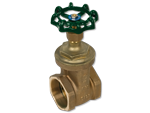
Ball valves have taken over most isolation work on Australian plumbing jobs, and for good reason: quarter-turn operation, a clear full-bore flow path when open, and an obvious handle position that tells you at a glance whether the line is live. Gate valves — the old screwed-bonnet, multi-turn, rising or non-rising stem design — look slower and more old-fashioned by comparison. But PSA still stocks a genuine range of bronze and brass gate valves, and they're not just legacy stock: certain jobs still call for one specifically, and picking the wrong pattern is a compliance and cost mistake worth avoiding.
First, the one rule that doesn't change regardless of which valve you pick: a gate valve is an isolation valve, not a flow-control valve. Left partially open to throttle flow, the gate itself erodes under the velocity of the water passing the narrow gap — a failure mode plumbers call wire-drawing — and the valve stops sealing properly even when fully closed. If a job needs to regulate flow rather than just shut it off, that's a globe valve or a proper regulator, not a gate valve held half-open.
Where a gate valve is still the right call
Confirmed WaterMark compliance for drinking water. PSA's Zetco bronze gate valve (1706) states its compliance plainly in the listing: WaterMarked to AS 1628 under licence WM-020284, rated 2000kPa, 15–100mm. That's the standard covering copper-alloy gate, globe and non-return valves for water supply, and a quoted licence number is the thing to look for before specifying any gate valve on a potable water line. Austworld's lead-free brass lines are described on their own listings only as "listed by Austworld as a WaterMark gate valve" — without a licence number quoted — so confirm the actual WaterMark licence with Austworld or PSA before relying on that line for certified work, the same caution this blog applies to any supplier claim that stops short of a quoted licence number. ACP's general-purpose brass gate valve is more straightforward: its own listing says plainly it's untested and not for applications requiring a WaterMark-certified valve, so treat it as a non-potable or mechanical-isolation valve only.
High-pressure and large-bore lines. Zetco's standard bronze pattern (1706) is rated to 2000kPa. The heavy pattern PN32 version (1719) steps that up to 3200kPa across 6–100mm, under the same WM-020284 licence. On a job sitting between those two ratings, the pattern — not just the size — is what has to change, and it's an easy detail to miss when a quote is built off a generic "gate valve, 25mm" line item.
Underground and meter-pit isolation. A wheel handle isn't an option on a valve sitting in a buried pit. Austworld's underground gate valve (UGV40LF/UGV50LF) is built with a key cap instead, designed to be turned from the surface with a standard valve key — the same reason meter assemblies and civil isolation points still specify gate valves over ball valves in a lot of cases.
Controlled access. Zetco's lockable gate valve (1707) ships with a padlockable cover over the handwheel — a XENOY thermoplastic alloy cover rated -46°C to 177°C, with multiple padlock provision and a rewritable safety label for inspection records — which matters anywhere isolation needs to be prevented by anyone without the key, such as fire services and shared-access plant rooms.
Large-bore economics in established pits and plant rooms. The handwheel bronze gate valve (1714) runs 65–100mm, where bronze construction gets expensive regardless of valve type. Gate valves remain the common fit here mostly because that's what the existing pit or plant room was already built around — matching the installed pattern avoids re-engineering the fitting run for a ball valve of the same bore.
Matching an odd thread standard. Zetco also lists an NPT-threaded bronze gate valve (1736) — American pipe thread rather than the BSP most Australian trade stock uses, rated to 2000kPa, -10°C to 99°C. Worth knowing about if a job involves imported equipment or fittings built to NPT, rather than assuming every gate valve on the shelf is BSP.
Servicing an existing valve. Austworld's replacement wheel and T-handle set (18 size/style combinations, DN15–DN100) covers a seized or snapped handle on a valve that's otherwise fine — cheaper and faster than replacing the whole valve body on a service call.
One honest flag on stock: PSA's Zetco bronze gate valves currently show 0 on-hand stock, but they're set to continue-selling (backorder), so they're still purchasable — just confirm lead time before promising a same-week install. See the full range in Gate Valves, and for the ball-valve side of this comparison on a stainless press system, see Isolating a Stainless Press Line. For a general primer on what WaterMark and WELS marks actually certify, see WaterMark & WELS Ratings Explained.
Frequently Asked Questions
Has everything moved to ball valves, or can I still buy gate valves in Australia?
Gate valves are still manufactured and stocked — PSA carries ACP, Austworld and Zetco ranges — but they're now the exception rather than the default for new isolation points. Ball valves cover most general isolation work; gate valves get specified for the particular jobs above: WaterMarked potable water lines needing an AS 1628 valve, underground/meter isolation, lockable access, high-pressure large-bore runs, or matching an existing installation.
Are all of PSA's gate valves WaterMark certified for drinking water?
No. Zetco's bronze range is WaterMark certified to AS 1628 — several listings quote licence WM-020284 directly. Austworld's lead-free lines are described as "listed by Austworld as a WaterMark gate valve" without a quoted licence number — confirm that licence before specifying one for certified potable work. ACP's general-purpose brass gate valve explicitly isn't for WaterMark-required applications.
What's the difference between a T-bar, key cap, wheel handle and lockable gate valve?
They're the same basic gate valve body with a different operating head for the install context: a wheel handle suits normal above-ground access; a T-bar or key cap suits meter assemblies and buried pits where a standard valve key does the turning; and a padlockable cover over the handwheel is for fire services or shared plant rooms where isolation needs to be restricted to authorised people only.
Can a gate valve be used to control flow rate, like a tap?
No — a gate valve is built for full-open or full-closed isolation only. Holding it partially open to throttle flow erodes the gate (wire-drawing) under the velocity of water passing the narrow gap, and the valve stops sealing reliably even when fully closed afterwards. Use a globe valve or a dedicated regulator for anything that needs to actually control flow rate.